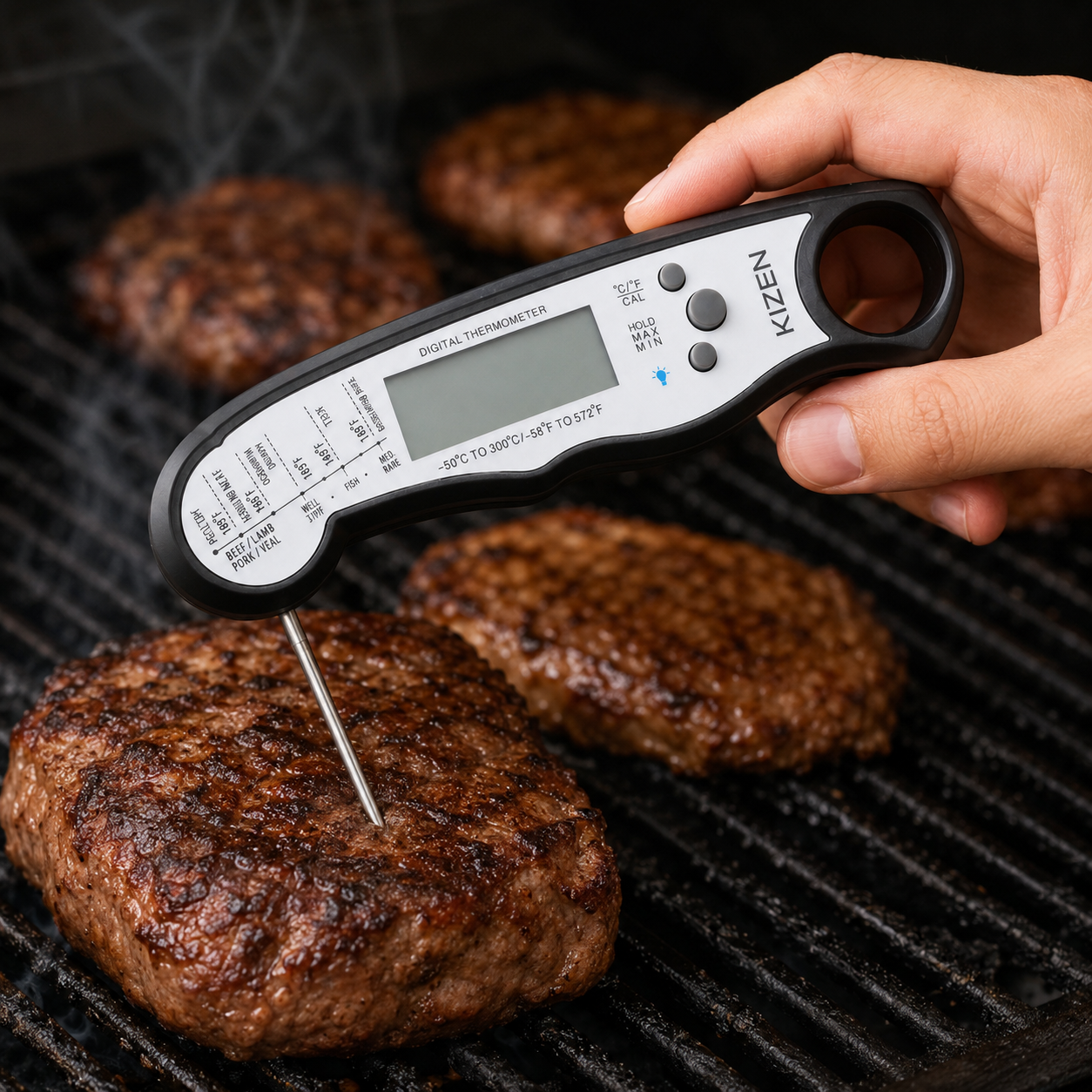
A digital meat thermometer is not hard to use. The mistake is usually not with the thermometer itself.
It is the placement.
If the probe is too close to the outside of the meat, the screen may show a number that looks useful but does not tell you much about the center. If the tip touches bone, the grill grate, or the bottom of a pan, the reading can be off. That is how someone can "use a thermometer" and still end up with chicken that needs more time or steak that went too far.
So before worrying about buttons, settings, or features, get this part right: the tip of the probe needs to reach the part of the food that cooks the slowest.
Start With the Thickest Part
For most meat, that means the thickest part.
With a chicken breast, do not check the thin edge. Put the probe into the thickest section and keep it away from bone.
With burgers, it is often easier to come in from the side. A thin patty can be awkward to check from the top because the probe may not reach the center properly.
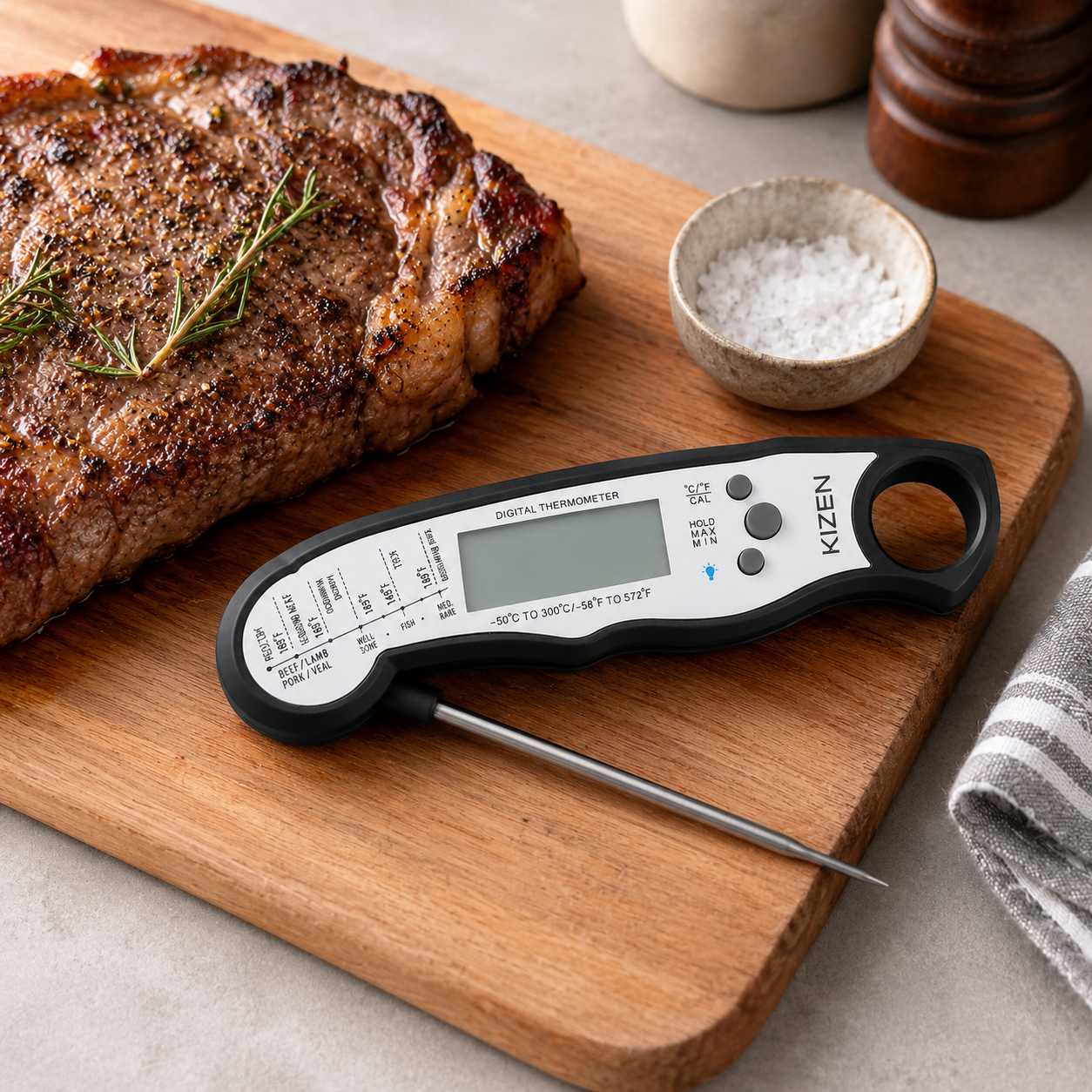
With steak, aim for the middle of the thickest area. If the steak is uneven, check the thicker end first.
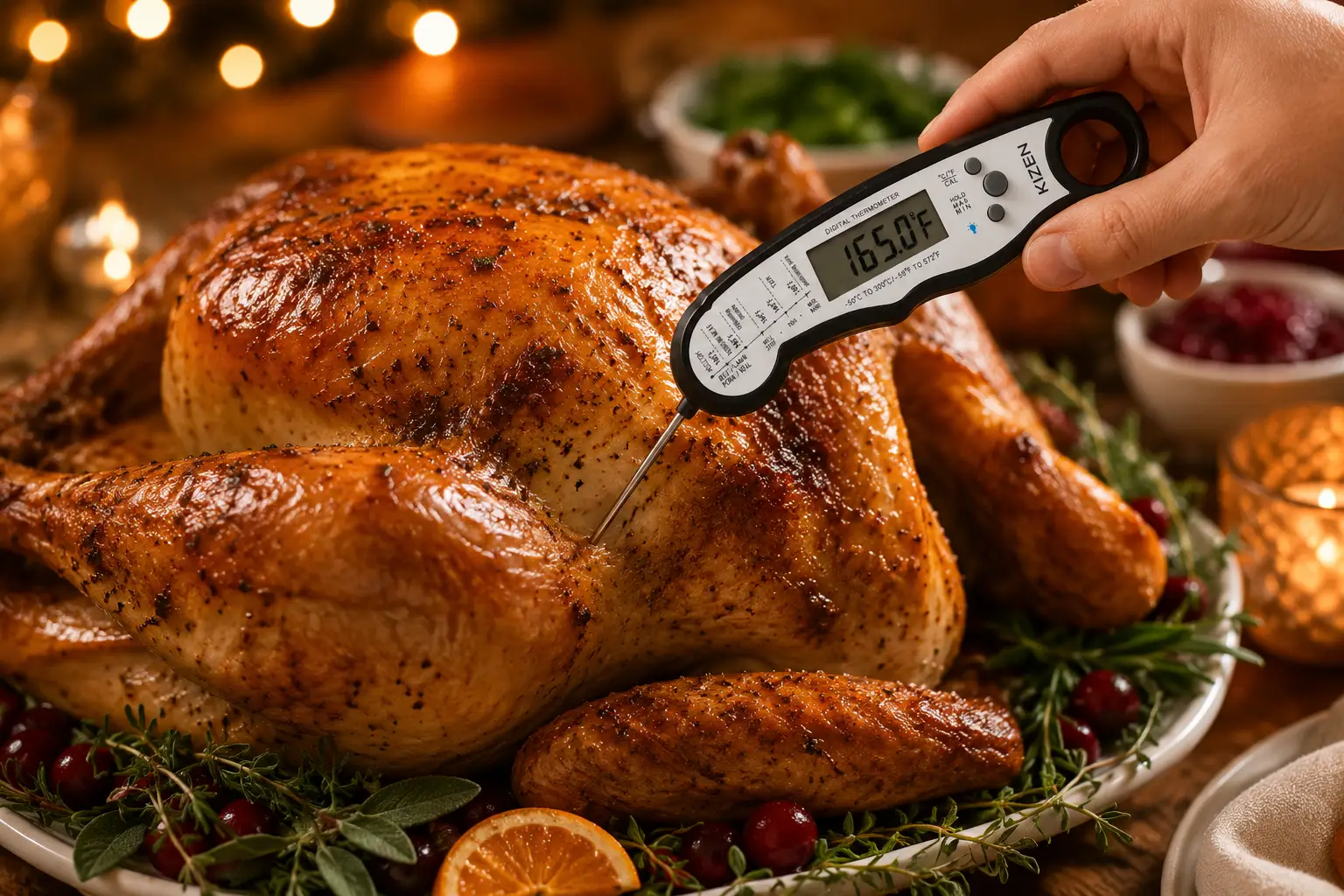
Turkey and whole chicken need more patience. One reading is not enough for a bird that large. Check more than one area, and do not let the probe rest against bone.
The same idea works for leftovers and casseroles. The middle is usually the part that heats last.
Why Cooking Time Is Not Proof
Cooking time can help you plan, but it is not proof. A grill has hot spots. Ovens do not always heat evenly. Two pieces of chicken from the same package can still be different sizes. Color can also fool you. Meat can brown outside before the center is where you need it.
That is why the thermometer matters. It gives you a number from inside the food, not just a guess from the outside.
How to Take a Reading
Turn the thermometer on before your hand is over the heat. Open the probe if it folds out. Insert the tip into the food and hold it still.
Do not pull it out the second the display changes. Wait until the number settles enough to read.
The KIZEN instant read thermometer is listed as reading food and liquid temperatures in as quick as 3 seconds, with accuracy listed at +/- 1°F. That is fast, but "fast" still means you should give the screen a moment if the number is moving.
For small pieces, one careful reading may be fine. For thick cuts, whole poultry, BBQ pieces, or anything uneven, check another spot. A second reading takes a few seconds and can save the meal.
Using a Thermometer on the Grill
Grilling is where people tend to rush the most. The lid is open, heat is escaping, and everything feels like it needs to happen quickly.
Try not to stab at the meat and trust the first number you see.
Move the food away from direct flame if you can do that safely. Insert the probe into the thickest part, not down into the grate. If the reading seems strange, check again from a slightly different angle.
A backlit screen helps outside, especially in the evening or in shade. The KIZEN digital meat thermometer has a backlit display, which is useful when the light around the grill is not great.
Beyond Meat: Liquids, Bread, and Candy
A thermometer can also be useful beyond meat if the product information supports it. The KIZEN listing says it can be used for food and liquid temperature checks, and it also lists baking bread and candy making.
For liquids, keep the probe tip in the liquid itself. Do not press it against the bottom of the pot. The pot can be hotter than the liquid and give you a number that is not what you meant to measure.
For bread or baked goods, check closer to the center rather than the crust.
For candy, follow the recipe temperature target and make sure the probe is reading the mixture, not the pan.
Cleaning and Care
Cleaning is not the exciting part, but it matters. Clean the probe after checking raw meat, and clean it before using it again on food that is ready to eat.
The KIZEN thermometer is listed as IP67 waterproof, and the seller notes that the probe and body can be washed under running water. It is not dishwasher safe, and it should not be soaked.
That detail is easy to miss. Waterproof does not mean dishwasher safe.
A Few Habits Make the Biggest Difference
- Do not check only the surface.
- Do not let the probe touch bone, metal, the pan, or the grill grate.
- Do not pull the thermometer out before the reading settles.
- Do not trust one reading on a large turkey, roast, or thick BBQ cut.
- Do not use an infrared thermometer as a replacement for an internal meat check. Infrared thermometers read surface temperature. A probe thermometer checks inside the food.
What to Check Before Buying
Before buying a digital meat thermometer, look at the details you will actually notice while cooking.
Reading speed matters when the oven door is open or the grill lid is up. Accuracy matters because you are using the tool to make a decision. A fold-out probe is easier to store. A backlit display helps in lower light. A magnetic back can be useful if you want to keep the thermometer near the cooking area instead of in a drawer.
Also check the care instructions. If Celsius and Fahrenheit switching matters to you, confirm that in the current seller details or instruction guide before ordering.
The KIZEN digital meat thermometer is listed with a fold-out probe, backlit digital display, magnetic back, battery-powered operation, IP67 waterproof rating, and 2 CR2032 batteries required.
Final Takeaway
The main thing to remember is simple: the thermometer is only as good as the spot you check.
Find the thickest part. Keep the probe away from bone and metal. Wait for the number to settle. Check another area when the food is large or uneven.
Once that becomes a habit, chicken, steak, burgers, turkey, BBQ, liquids, and oven meals are much easier to judge without relying only on color or cooking time.
Related Guides
- How to Choose a Digital Meat Thermometer
- Digital Meat Thermometer vs Infrared Thermometer
- KIZEN Digital Meat Thermometer Review
Affiliate Disclosure: This article may include affiliate links when final product URLs are added.